Showing posts with label Culture. Show all posts

Wednesday, 20 March 2019

5 Day Garden Route Tour: 23 - 27 Oct 2019


Day 1
We depart from Cape Town at 7h30am (please refer to Pre-Departure Information) and travel via pretty Hermanus (only in season) which is famous for its miracle of nature as the Antarctic whales come into Walkers Bay to calve (seasonal). Our route to Mossel Bay is via farmlands of apple/pear orchards and rolling hills with lunch on route. From here we drive along the scenic route to Knysna/George, our overnight stop for 2 nights.  

Day 2
After a good breakfast we drive via George and the picturesque Outeniqua Pass to the Mecca of South African ostrich farming – Oudtshoorn. Here we visit one of the many Ostrich Show Ranches, the Cango Wildlife Farm and an optional visit to the dripstone cave – Cango Caves* is possible on request (optional cost as it is not wheelchair accessible at all). After a leisurely drive back with breath-taking views we relax for the 2nd night at Knysna/George.
(B)

Day 3
Today we drive via Knysna, trough Wilderness and the Lake District, one of the world’s most picturesque drives. After a fascinating stop at Knysna Head and a boat cruise* (weather dependant & optional extra cost) on Knysna Lagoon we travel to the heart of the Garden Route – the Tsitsikamma National Park - which embraces an 80km strip of superb coastline together with a marine reserve that stretches 5 km offshore. Here you can relax or take walks in the forest which is richly endowed with plant life and birds, the rock pools teem with colourful marine life; and whales, dolphins & sea otters can often be seen sporting close to the shoreline. (B)

Day 4
In the morning you have the chance to visit the Monkeyland*, Birds of Eden* and the Elephant Sanctuary* (*optional extra cost) where you can do a “Trunk in hand tour” (Elephant-back Ride* also available on request at optional cost) or you can take some time out and just relax. After an exciting or peaceful morning, our journey takes us to Stormsriver, the Adventure centre of the Garden Route with the Bloukrans Bungi-jump* (216M!!), one of the highest in the world. We take a leisurely drive along more fantastic coastline before returning to Tsitsikamma Forest for the second night. (B)

Day 5
On our last day we take a leisurely drive along the breathtaking coastline to the 5th largest city in South Africa - Port Elizabeth, also known as “friendly city” or “windy city”. On arrival in PE the tour ends (B)

Please note that the above itinerary can also run in reverse and other changes may occur due to accommodation availability or other unforeseen circumstances

For more information please visit: Garden Route

Wednesday, 14 March 2018

RIP – Stephen Hawking – what an inspiration to us all!

“It would not be much of a universe if it wasn’t home to the people you love.”
“Look up at the stars and not down at your feet. Try to make sense of what you see and wonder about what makes the universe exist. Be curious, and however difficult life may seem, there is always something you can do, and succeed at. It matters that you don’t just give up.” - Professor Stephen Hawking


Thursday, 1 September 2016

African Folklore Collection: Volume 2

Since July was inspired by superheroes and superheroics (in honour of Comic Con), we at Epic recalled some folklore tales from our continent that we felt fit the theme. The animals in these stories are totally worthy of being called heroes - read about their feats below!

How Eagle Saved Monkey from Hyena


A Ghanaian folktale tells the story of a Hyena who fell into a trap in the ground and could not get out. He cried for help, but he had such a bad reputation for being treacherous that all the passers-by refused. Until, finally, kindly Monkey heard his cries and lent a helping hand, despite his instincts. And, true to everybody's suspicions, Hyena attacked Monkey!
Eagle flew overhead and spotted the struggle. He swooped down and pulled Monkey away from Hyena, then demanded to know what was going on. Monkey explained what Hyena did. Eagle wanted to see exactly what had happened and asked Hyena to recreate the scenario. Hyena obliged, and got climbed back in the trap, realizing too late that Eagle had tricked him to save Monkey!

How Zebra Got His Stripes


A Bushman folktale tells the story of how the zebra got his stripes - by saving the animals' only water supply from the villianous baboon! 
The baboon had claimed the watering hole for himself, and to chase the thirsty animals away, he lit a big fire next to the water. 
One day, the zebra, his coat gleaming a pure white in the burning sun, approached the water, wanting a drink. The baboon, angry, shooed him away, but the zebra rightfully said that the water belonged to everyone. And so, they fought for it, and the battle raged, until the zebra kicked the baboon so hard that the baboon went flying - and the zebra lost his balance and fell into the scorching flames of the baboon's fire! The burning sticks and logs seared black stripes into his fur, and to this day, the zebra wears these markings as a badge of honour.

How the Hare Saved the Animals


There's a story of a hare that saved all the animals from becoming the lion's dinner. The lion had requested that each day, an animal must be brought to him to eat, or he'd hunt them all down. The animals had obliged, each one living in fear that their turn to be dinner would be next. One day, it was the hare's turn, but instead of shaking in fear, he smiled knowingly, and just before presenting himself, he rolled in the dirt, covering himself in mud. The lion turned his nose up at the unappetizing creature,, and the hare told him that he was supposed to deliver a big juicy hare, but another lion stole it from him! And, just as the hare suspected, the lion wanted to jealously fight this other lion, so hare led him to a well, pointed at lion's reflection and told him that was his foe. The lion jumped in head-first, and never resurfaced.

Follow us on social media and look out for the #FolkloreThursday hashtag! We're on Facebook, Twitter and Instagram!

Tuesday, 9 August 2016

4 Incredible Female Disability and Gender Equality Activists from Africa

Every year on August 9th, South Africa honours women: we celebrate the everyday women, the  mothers, the daughters, the career-women, the caregivers, the teachers - all women, who are all bettering the country every day.


This year, Epic is especially inspired by women with disabilities throughout Africa: 4 powerful women who are achieving truly great things for women, with and without disabilities. Here are their stories:


  1. Shelley Barry

Shelley was travelling with a friend in 1996 on on one of the minibus taxis widely used by millions of commuters around South Africa. In a rare turn of bad luck, a gunfight broke out between two rival taxi groups, and a bullet struck Shelley, rendering her paralyzed ever since (her friend had survived the taxi violence, too).

Now a wheelchair user, Shelley has forged a successful career in media, simultaneously making a name as a unique visionary and as a voice for people with disabilities (her films are often shot from the perspective of a wheelchair user). Among other achievements, she was a driving force behind the HIV/AIDS awareness campaigns aired on local television station eTV, has addressed the United Nations in New York City, is an anti-gun lobbyist, and has won many many international awards for her films. She has also written plays about the oppression of women (“Insignificant Others” and “En Route to Bury Sara Baartman”).

As if all that wasn’t enough, she’s also worked as the Media Manager in the Office on the Status of Disabled Persons in the Presidency in South Africa, and as the National Parliamentary Policy Co-Ordinator for Disabled People South Africa during Nelson Mandela’s presidency.

She also has founded Two Spinning Wheels Productions and is a lecturer in film studies at the University of the Western Cape. Shelley is proof of art’s role in creating and inspiring social change, and just how important art is in a society.
You can see some of her work on her YouTube channel.

  1. Gertrude Oforiwa Fefoame

    http://s160131.gridserver.com/wp-content/uploads/gertrude-oforiwa-fefoame.jpg
    www.cehjournal.org

Ghanaian gender and disability activist Gertrude Oforiwa Fefoame lost her eyesight as a child, and knows first-hand about the struggles facing women with disabilities in a developing country. She studied to become a special education teacher and also hold an executive master’s degree in governance and leadership.

She currently works as a Global Advocacy Advisor for Sightsavers, an international NGO working in developing countries to treat avoidable blindness, and also as Vice Chairperson for ICEVI Africa.
Gertrude recognizes the intersections of the different identities she speaks for and is a part of: being a woman with a disability in a developing African country comes with its own unique set of challenges, and Gertrude’s work is not unrecognized: the Ghanaian government’s Ministry of Gender, Children and Social Protection nominated Gertrude for a position on the UN’s Committee on the Rights of Persons with Disabilities.

Her work goes to show that anybody, born anywhere under any circumstances, has the potential to shape their world.

  1. Yetnebersh Nigussie


http://www.yegara.com/am/sites/default/files/styles/facebook_size/public/12240087_1484549341854765_4029046066471709399_n.jpg?itok=iK1GkyDI
www.yegara.com
Yetnebersh Nigussie was only five years old and living in the rural Amhara Saint Wollo when she lost her eyesight. She considers this her blessing: able-bodied young girls are often subjected to early marriages. She was afforded an opportunity to attend a boarding school for the blind and then the opportunity to attend high school, something which less than 20% of teenagers have access to in her region.


She’s put her education to more-than-good use: during her schooling, she chaired at least 6 students’ clubs at her high school, and founded the Addis Ababa University Female Students Association and chaired the university’s Anti-AIDS movement in the mid-2000’s.

Now an attorney, she’s volunteered for over 20 organizations, which led to her local organization Ethiopian Centre for Disability and Development. The organization works with other notable Ethiopians to include and empower people with disabilities in development programmes.

This is particularly difficult in Ethiopia: Yetnebersh has said in 2014 “In Ethiopia, I’m not sure if you are aware, we have a new law that was passed three years ago, and that law requires organizations receiving funds from abroad not to engage in disability rights and awareness.”

Despite the obstacles, Yetnebersh has achieved a lot for her country. One of those that she’s most proud of is helping to ensure that all new buildings are required by law to be accessible to people with disabilities. She’s also opened up the Yetnebersh Academy, a school for underprivileged children. She says, “I think the more challenges we have, the more innovative minds there will be to tackle them better. I believe that one day we will have a world for all.


  1. Chaeli Mycroft

    http://www.kidsrights.org/portals/1/IMG_9753.jpg?ver=2016-01-08-143021-307
    www.kidsrights.org
Michaela “Chaeli” Mycroft has been a force for disability causes since she was nine. The South African young activist was born with cerebral palsy, and her upward trajectory along the path of disability rights started when she and her sisters and their friends successfully raised over R20,000 (~$2,400) for a motorized wheelchair, which Chaeli had needed. This success, achieved by selling cards and flower pots, inspired Chaeli to found The Chaeli Campaign.
The Chaeli Campaign has since employed twenty people, and has won then-17-year-old Chaeli the 2011 International Children’s Peace Prize - the junior version of the Nobel Peace Prize. She was also the youngest finalist of the Shoprite Checkers / SABC 2 Woman of the Year Award - when she was ten - and in 2012 received a medal for Social Activism at the Nobel Laureate Peace Summit.

The Chaeli Campaign helps over 3000 children every year, providing much needed equipment and resources to children with disabilities in South Africa - from wheelchairs to food supplements. They also run weekly workshops which teach young adults craft skills and entrepreneurship skills: they make Sebezaphones and bean bags, and are paid for their craft.

Chaeli has said “We are all different and we all have the need to be accepted, regardless of having a disability or not.”.

We hope you enjoy this year’s Women’s Day! Never forget your power.


Sources: 
http://www.iamwomanseries.com/our-stories/season-2-all-episodes/episode-17-shelley-barry/
http://streettalktv.com/teammember/shelley-barry/
http://www.africanfilmny.org/2013/shelley-barry/
http://www.zoominfo.com/s/#!search/profile/person?personId=213743200&targetid=profile
https://twospinningwheels.wordpress.com/directors-bio/
http://www.mediaclubsouthafrica.com/land-and-people/2683-disability
http://chaelicampaign.co.za/
http://www.africanchildforum.org/site/_archived/index.php/disabilitysymposium/295-ms-gertrude-oforiwa-fefoame.html
http://www.graphic.com.gh/news/general-news/manifestation-of-gender-inequality-no-woman-elected-onto-un-committee.html
http://www.wickedlocal.com/x1465131669/Fenn-students-raise-money-for-children-in-Ghana 
https://en.wikipedia.org/wiki/Yetnebersh_Nigussie
https://www.theguardian.com/global-development-professionals-network/2016/jun/22/10-activists-changing-lives-disabled-people-around-world
http://www.tadias.com/06/17/2014/yetnebersh-nigussie-advocates-for-inclusion-for-people-with-disabilities-in-ethiopia/
http://www.ilo.org/wcmsp5/groups/public/---africa/documents/publication/wcms_237420.pdf

Monday, 1 August 2016

African Folklore Collection: Volume 1

Every Thursday, Epic likes to discover and share ancient African tales: of animals, magical beings and fantastic happenings.
The lush, diverse African continent is full of these tales and they deserve to be preserved - so we've collected all of the ones we've posted onto our social media channels so far, with more to follow.

Here's the first volume, first posted in June 2016:

The Elephant's Trunk


The elephant used to have a small snout, which he liked, but it made feeding uncomfortable as he'd often have to use his knees. One day, while drinking water at the river, he caught the attention of a crocodile, who decided that the elephant looked very tasty. He sneaked towards the elephant beneath the water, lunged forward and grabbed the elephant's snout. Luckily, the elephant was too strong for the crocodile to pull him beneath the water, and he stood his ground. The crocodile was relentless and only after an hours-long tug of war did he give up - leaving the poor elephant with a stretched-out nose.

The Ostrich and the Jealous Lions


There's an old Bushmen tale of some proud male lions who were jealous of the ostriches, for all the lionesses admired the ostriches' voice. The lions were belittled by their women, who said they spoke as if they had their tails in their mouths.
The lions thus conspired to tear at the ostriches' chests and rip out their lungs, in the hopes that eating the lungs would grant them a voice as deep and as full as the lionesses liked. 
Today, the lions all love to show off their famous roars.

Mermaids of the Karoo


Rumours and legends about mermaids and merfolk have been swirling around Southern Africa for millennia. In the Klein Karoo, the home of the ancient Khoisan people, are rock paintings of mermaids - perhaps strange for a rather dry part of South Africa, until you remember that 250 million years ago, the Klein Karoo used to be an ocean! Still, more recently, are local claims of mermaids combing their hair by little rock pools.

You can find more stories by exploring the African Folklore tag, and you can stay up to date by following us on Twitter, Instagram and Facebook - look out for the #FolkloreThursday hashtag!

Thursday, 14 July 2016

7 Empowering Webcomics About People with Disabilities


Webcomics are one part of the internet that we think needs a lot more love. They’re created by hardworking, passionate artists and writers who, more often than not, are drawing and plotting for the love of it. It’s helped many people express their visions freely, and they often do it for little to no pay.


There is an absolutely vast sea of webcomics out there, covering every genre and topic one can think of. Because we think that disability needs more positive representation, we’ve scoured the corners of the net for webcomics that not only portray people with disability well, but centres on those people respectfully: acknowledging their agency, their ambition and that they have personalities beyond being someone else’s inspiration.


If you’re into short, funny comic strips, The Disabled Life is fantastic. It’s created by two sisters, Jessica Oddi and Lianna Oddi who are both wheelchair users. They chronicle their experiences as 20-something women navigating life in a wheelchair in a light-hearted and hilarious way: touching on fashion struggles, online dating and body image.  The comics are posted with a text description for those with slow connections, small screens and vision impairments, which is a great step towards making their content accessible for everyone (and the more people who read it, the better, because it’s really great).

[Image Description: drawing of a girl swinging across in a ceiling lift and sling, kicking out her arm and legs, singing “I CAME IN LIKE A WRECKING BALL!”]
How we feel almost every time using the lift.
Read it here
That Deaf Guy is another great comic strip. It’s written by husband-and-wife team Matt and Kay Daigle: he’s the stay-at-home-dad of Cedric and she works as an American Sign Language interpreter, and the web comic follows their everyday lives. It’s a very sweet, funny and light read, and occasionally,  a strip will focus on the “Dos and Don’ts” of communicating with a deaf person, which, in an ableist world, is always worth sharing.

02/18/2016
Read it here

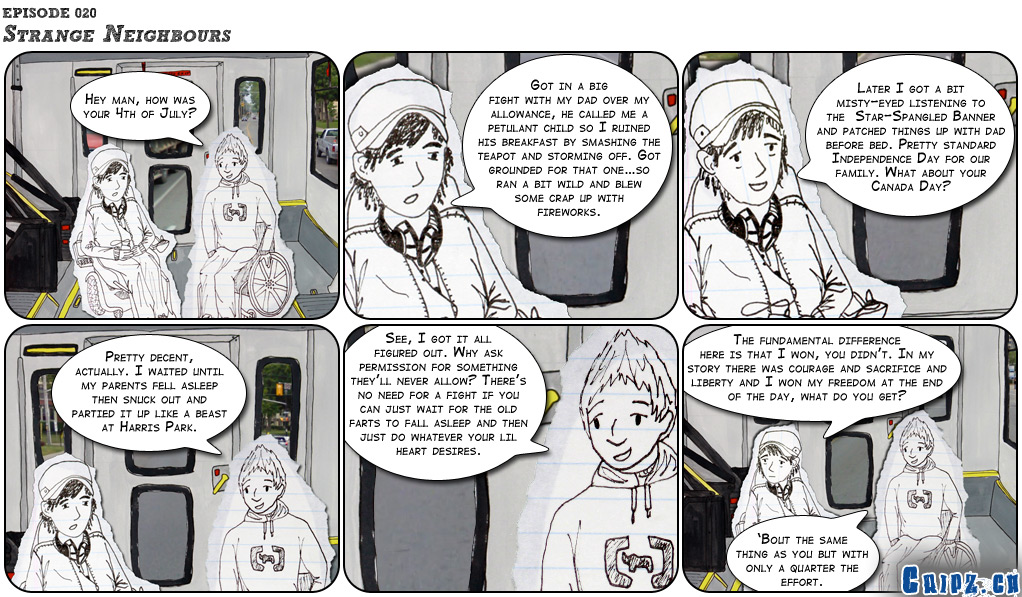
For humour with a little more bite, there’s Cripz, which is about two high-school weirdos, Rhett and Griff, who happen to be wheelchair-users (they’re careful to mention that their weirdness has nothing to do with their disabilities,and vice-versa). The creators, Jeff Preston and Clara Madrenas, have crafted a fun, smart and unique comic with a really cool art style. Unfortunately, the comic has been discontinued (for now) but there are plenty of past strips to enjoy.

Read it here

Online disability magazine Disability Intersections has a couple of webcomic series created by Anna Hamilton. She writes and draws about her experiences as a woman with multiple disabilities through a critical lens that acknowledges other marginalized identities, and how they intersect with disability. Allergies, chronic pain and anxiety are a few of the areas explored through this lens and it’s done with humour, quirky drawings and (content note) a little swearing.  It’s good for those who are looking to learn more about the social complexities of identity, and it educates without being intimidating. Like The Disabled Life, the comics are amended with a text description.


Read it here

If an overarching plot is more your thing, take a look at Absent-Minded Theatre, a dark comedy/affectionate parody set in a fantasy world of magic, starring a little girl born without legs and a right arm. This little girl, Daisy, is determined, headstrong and opinionated - traits anybody needs if they have to save their single father from a witch’s clutches. The series wrapped up in January 2016, but there are pages upon pages of story for new readers to get through. (Just a little content note: it’s suitable for a more mature audience; we’d say 16+, for the youngest.)

Read it here
A newer web comic, which was first released in January 2016, is The World In The Morning, which is a slice-of-life story about living with mental illness. The artwork is really rich and beautiful, the cast is diverse, and the story is sincere and sweet. The story is still very very new, but it's rightfully made quite a few fans already and we’re definitely looking forward to more instalments!

Read it here
Finally, if you’re looking for a more classic superhero story, check out Handicape, a story about wheelchair-user Ethan who discovers he has rare powers and that he has to fight a dark conspiracy involving his hometown (as well as people telling him that he’ll never amount to anything much because of his disability: the series starts off with his school guidance counsellor telling him that he won’t be able to follow his dreams of going into law enforcement and should settle for a desk job). It’s a classic underdog story that has resonance, and it will definitely appeal to any comic book fan.
conspiracy
Read it here
Do you know of any more webcomics about people with disabilities? Let us know!

Wednesday, 6 July 2016

6 Superheroes With Disabilities (That You've Never Heard Of)

We’ve been inspired by the upcoming Comic Con! July 2016 is dedicated to superheroes and superheroics and we’re super-inspired by the epic barrier-breaking stories of these fantastic beings - with and without disabilities!


In the media and within popular culture, disability has had very little positive representation. Many disability rights advocates have slammed the various portrayals: although there have been quite a few, most of the stories are centred around an able-bodied person, and the person with a disability has little to no control over their own role within the story.


However, there has always been a bond between superheroism and disability - and we don’t mean in the pandering, inspirational sense.


Mainstream comic book publishers like Marvel and DC have actually been quite progressive when it comes to disability visibility, especially for the 1940’s, when Marvel introduced their first blind superhero, Doctor Mid-Nite. There has been an extremely diverse array of multi-dimensional superheroes, spanning virtually every identity - but mainstream culture hasn’t been too aware of most of them, save for Daredevil (blindness), Deadpool (facial disfigurement, cancer, chronic pain, dissociative personality disorder) and the X-Men franchise (a metaphor for disability rights struggles).


Because we believe that more positive representation can only be a good thing, here’s our list of six awesome superheroes with disabilities:


  1. Silhouette

Born in New York City to parents that have maintained a legacy of careful, selective breeding (so she would be able to tap into the power of the Well of All Things in Cambodia), Silhouette was shot by police gunfire, which caused the loss of functionality in her legs. She’s since added “superhumanly fighting with her custom combat-crutches” to her already extensive list of abilities (which includes being able to melt into shadows and teleport) - paraplegia hasn’t stopped her from being a hero.


  1. Misty Knight
Also hailing from New York, Mercedes “Misty” Knight was one of the best cops at the NYPD, until a terrorist bombing left her without an arm. She was offered a desk job, but was unhappy with being confined to a desk, so, equipped with a bionic arm that grants her exceptional punching and crushing force, she founded Heroes for Hire with her best friend, to whom she maintains fierce loyalty. She also boasts ambidextrous marksmanship and detective skills that would put Sherlock to shame.


  1. Karma
A native of Vietnam, Xi’an Coy Manh has learned to stay calm during times of crisis, having grown up around war-zones with her army general uncle. She is incredibly kind, calm and unselfish - except briefly when her powers of psychic possession were used against her by the evil Shadow King, whose influence caused her to abandon her true personality for one of evil - and which also forced her to put on a lot of weight rapidly to the point of morbid obesity. She has since lost the weight and regained her sense of self, but her leg has been amputated: she now wears a prosthetic, but still possesses superb psychic abilities.


  1. Hornet
Eddie McDonough succeeded Peter Parker as the Hornet, and received the Hornet suit which he modified to allow him the use of his palsied right arm (as well as flight and enhanced strength). The suit helped his confidence as he felt that people saw the superhero and not the disability. He was sadly killed by a possessed Wolverine, but Eddie is still remembered for his superheroism as Hornet and his civilian status as a science prodigy.


  1. Black Bolt
Black Bolt has an unusual disability which could also be seen as a super-ability, depending on your point of view: he has a hypersonic voice, capable of destroying entire cities with just one utterance! He has to work extremely hard to remain silent at all times, and communicates via sign language or a spokesperson. He’s reluctantly taken on the position of King of the Inhumans, a race of humanoid beings who came to be after an experiment, who now live in isolation and distrust of humans. Black Bolt is widely considered to also suffer from depression.


  1. Vengeance Moth
A 19 year-old recovering substance abuser who has muscular dystrophy, Drew Fisher has fantastic powers and, from her wheelchair, is a fully-involved member of The Movement, a crime-fighting superhero team. She is able to project a glowing green moth, which allows her to fly or to transport allies, project offensive rays from her moth’s wings, and create a force-field that shields her from her attackers.


Who’s your favourite superhero with a disability? Or do you better identify with the supervillians? Let us know!

-Jessica


Tuesday, 28 June 2016

Disability in Africa: Superstition and Tradition

disability in africa

What do you think of when you hear the words “disability” and “Africa”? Perhaps an image of poverty-stricken children with polio comes to mind, or maybe you’ll picture charities like Doctors Without Borders working tirelessly to better the sickly.


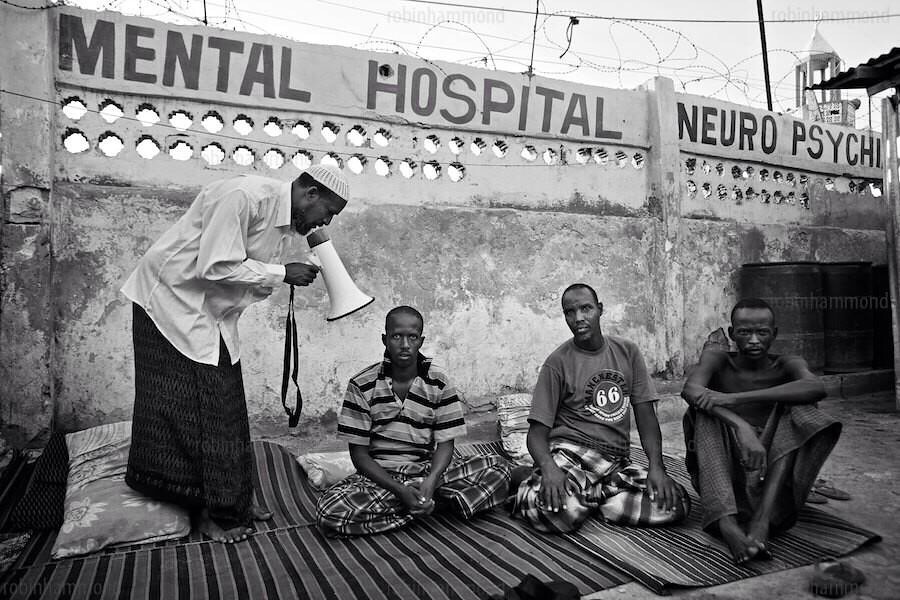
While there is still a lot of work to be done in furthering disability rights and dismantling ableism throughout Africa, the continent is so vast, so full of history and so rich with culture that, for centuries, there has been plenty of time devoted to considering special needs. People with all kinds of disabilities have been the subject of folkloric tales, spiritual icons, sources of wisdom and symbols of togetherness and respect.


There is a more wholesome, holistic and spiritual view of disability in most traditional communities: there is less focus on “fixing” or “rehabilitating” various physical and mental limitations, but rather an acceptance of people’s different needs, particularly in Sub-Saharan Africa. While it is important to note that some tribes and societies are guilty of ableism (and modern societies are not much better), acceptance, inclusion and reverence of the differently-abled is quite common.


Flickr | Robert Hammond
In contrast to western concepts, disability is not usually seen as one conglomerate: for instance, in Tanzania, the term “ulemavu” has only recently been used for disability in general. Throughout history, different disabilities have been considered separately from one another: deafness and paraplegia would not be seen as related issues. Although, more similarly to western definitions, some indigenous societies define disability as “a limitation in social role functions resulting from physical, sensory or emotional abnormalities and is of a spiritual nature” (Interestingly, emotional issues have yet to be fully accepted by mainstream society as disabilities).


It’s widely considered rude to laugh at somebody’s disability. A Songye proverb says “Tosepanga lemene, Efile kiakupanga” — “Don’t laugh at the disabled person, God keeps on creating you”. It’s commonly thought that mocking disability would cause one to suffer disability, whether by a future accident or by bearing a disabled child.


Disability is also associated with great power. A person with one eye is said to see better than a two-eyed person. The Ga from the Accra region in Ghana believe that people with mental disabilities are reincarnations of deities, and are treated with kindness and patience. In Sub-Saharan Africa, any irregular birth — from breech birth to birth defects — is treated especially ritualistically. In Benin, children who were born with anomalies were believed to be protected by supernatural forces and brought good luck. The Kurkana of Kenya see such as children as gifts from God, and must be taken care of as well as possible, in fear of God’s wrath. In Tanzania, the Chagga people believed that people with disabilities protected the community from evil spirits by serving as a pacifier: the presence of a person with a disability satisfied the needs of the evil spirits, and in doing so was treated with respect for keeping the whole community safe.  


It’s important to remember that, in many African countries, community is extremely important: family is seen as the most important social unit, not the individual. While this has been used against the differently-abled (in the sense that performing physical tasks to better the community is prized), this is also used as motivation to treat everybody with respect. A Shona proverb from Zimbabwe states “Benzi hunge riri rajo, kudzena kwaro unopurudza” — if someone with a mental disorder is a member of your family, you applaud his dancing.


The agency of a person with a disability isn’t taken away in many tribes. The Maasai of Kenya accept women with disabilities bearing children, and she is allowed to stay in her family home as “the girl of the homestead” instead of moving in with her husband’s family, which is a privilege in Maasai culture. In the same tribe, children with disabilities are treated the same as able-bodied children, participating in the same rituals. The Hausa people of northern Nigeria and southeastern Niger have disabled communities, represented by a leader with the same disability (this social structure goes for every community and profession in Hausaland).

Indeed, many African countries don’t see people with disabilities as being fundamentally different; a person with a specific impairment is seen as just that. The disability does not define who they are, and their contributions to their communities are valued as much as anybody else’s. According to many an East-African proverb, every person has been placed on the earth for a reason.


Sources:
http://www.rds.hawaii.edu/ojs/index.php/journal/article/viewFile/110/367
http://dsq-sds.org/article/view/3197/3068
Encyclopedia of Disability - Volume 5
Hausa Superstitions and Customs